By Olivia G. Ford
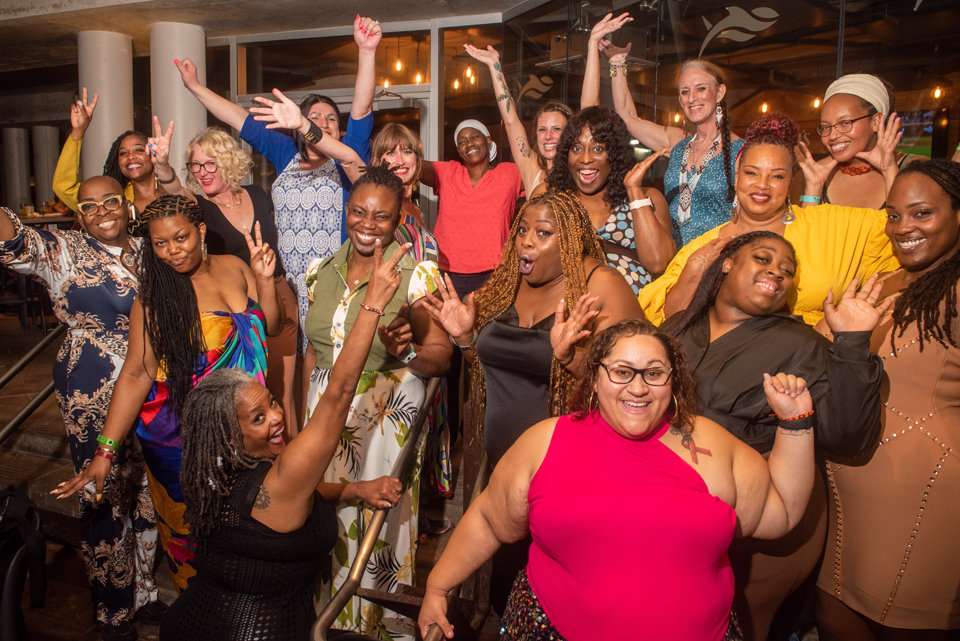
The Well Project's team and community advisory board (CAB) members again had a strong presence at this September's United States Conference on HIV/AIDS (USCHA 2026) in Anaheim, CA. The core of that presence this year was our booth in the exhibit hall. During its open hours there were always at least one or two women with deep ties to The Well Project ready to answer questions and share our lauded free print materials. All of us were extremely busy with multiple, often overlapping commitments throughout the conference; the booth was a place for The Well Project's loved ones to touch base, sip some water (or nip from our bowl of candy), retrieve misplaced items, get a hug, take a breath.
We also got to walk the hall and visit longtime friends and collaborators from some of our partner organizations at their tables, including Center for HIV Law and Policy, National Working Positive Coalition, POZ Magazine, and in the booth right next door, National Network to End Domestic Violence's Positively Safe team. Transgender Law Center's booth was right down the aisle as well, staffed in part by our beloved CAB member and frequent conference reporter Katie Willingham. Katie captured the magic of the USCHA exhibit hall in one of her follow-up articles from the conference. It is truly a vibe that is difficult to replicate virtually in this age of Zoom.
The Well Project had two workshops in the USCHA program that allowed us to present and inform community members on key areas of our recent work. "Language Matters in HIV Care and Prevention: Results from a Community-Based Survey Among Women and Nonbinary Adults Living with HIV" brought together our own Bridgette Picou, LVN, ACLPN (director of partnerships and stakeholder interests), Ciarra Brown, MS, HS-BCP (director of programs), Krista Martel (executive director), Kim Canady, BS (CAB member and Conversations with Kim founder), and me (Olivia G. Ford, editorial director), for a panel sharing findings from the "Words Matter" study we conducted last year alongside a stellar group of expert advisors. Participants left energized and eager for more evidence-based tools to train healthcare providers and staff to watch their language – for the health of those they serve.
The next day, Ciarra and I joined CAB member and HER Voice founder Ashley Cason to present "Assessing Parents' Priorities for Postpartum Education and Support: Strategies to Address Identified Gaps" before a small, passionate, engaged audience that included several birth workers (and two people who shared that they were currently pregnant!). Again, participants were glad to leave with access to a new tool to support their work: Our series of checklists geared for new parents living with HIV preparing for birth and the often taxing year that follows. We deeply missed CAB member Heather Rhea, who co-developed our workshop and has been instrumental in so much of our postpartum and infant-feeding work, but was not able to attend USCHA in person this year. They were absolutely in that room in spirit.
Team members presented on other crucial topics throughout the conference, including rolling out long-acting injectable HIV medications (Bridgette, along with the brilliant Kim Skeete) and advancing meaningful involvement of people living with HIV (Ciarra, featuring a deep bench of current and past CAB members: Kim, CAB co-chair Lynette Trawick, and Masonia Traylor). Ashley also wrote about a three-hour Institute co-presented by Masonia.
On the final morning of the conference – a Sunday, and a notoriously "sleepy" time slot for a workshop – Ciarra and Bridgette woke us all up and sent us off with an engaging presentation on the RISE Infant Feeding Framework, which is an HIV-inclusive, theory-informed model, developed by colleagues at several universities and informed by contributions from The Well Project, that strives to integrate trust, equity, and justice into infant feeding decision-making.
The three full days of USCHA 2026 each included a plenary luncheon, hosted and programmed respectively by ViiV Healthcare, Gilead, and Merck, the "Big Three" of HIV drug companies. All three included eye-catching spectacles and amplified voices of powerhouse advocates from across our community. The final day's plenary, however, was a standout. First and foremost, the program featured our incomparable, insightful, luminous team member Bridgette, sharing a slice of her experience with poise and power. Ashley from our CAB also graced the stage with her voice; and we were treated to the wisdom of other amazing members of our wider circle, including Tori Cooper, Leisha McKinley Beach, and Terri Wilder. The plenary was titled "All That You Touch, You Change," borrowing that and other iconic quotes from famed Black speculative fiction author and visionary Octavia E. Butler to frame the program's theme of growth and interconnectedness.
The dazzler of the afternoon was the special guest host: pioneering director, actor, dancer/choreographer, producer, educator, advocate, all-around Queen of All She Surveys, Ms. Debbie Allen. Amid intense pushback from her network, Allen directed the groundbreaking 1991 episode of the sitcom A Different World in which a pre-Martin, post-School Daze Tisha Campbell played Josie, a Hillman College student who discloses her HIV diagnosis to uninformed classmates and a supportive professor (played by Whoopi Goldberg). Allen took the plenary stage alongside Jasmine Guy, who starred in the original series and returned for the Netflix reboot. Both women spoke of witnessing the earliest days of the HIV epidemic from within a community of Black creatives that suffered devastating losses.
While Allen, Guy, and numerous others on the plenary stage and throughout the conference spoke of the importance of bold activism, many USCHA 2026 attendees noted the absence of such boldness from conference organizers. "I heard some people's fears and concerns about our future, about our present, and how we were going to live through this time in our history," wrote Katie in one of her conference articles; "I could feel Trump weighing on everyone's minds and emotions and it led to some emotional, distressing conversations. But NMAC said nothing." The lack of formal acknowledgement of the terror wrought by the current US administration certainly lands like a gut punch, and the dearth of calls to action from the stage to the thousands gathered to channel our rage, fear, and considerable skills into mass organizing, around the impending midterm elections and beyond, like a missed opportunity.
It seems that every year the takeaway from USCHA is that despite, or even because of, any grievances or other challenges regarding the conference, gathering itself is a reason to attend. I hope we continue to do so in this and many other ways for a long while to come.
More from The Well Project on the 2026 United States Conference on HIV/AIDS (USCHA 2026)
The Magic of the Exhibit Hall: A Recap from USCHA 2026
Supporting Trans Leadership in Cis-Led Organizations: A Recap from USCHA 2026